Artist Statement
September 2026
My work begins with form: the curve of a canyon wall, the rhythm of water over stone, the architecture of a seed pod or a storm system. From metal, hardwood, stone, polymer, and paper, I create objects that carry these observations — then I open them up. Through holes, gaps, and perforations, I excavate the solid until what remains is held in tension between presence and absence, structure and dissolution.
Round, drilled holes appear throughout my work, and their significance is both deeply personal and endlessly open. For most of my life, I saw no deep intellectual reasoning behind my creation of holes, the defining element of my work. It was simply the product of a lifelong obsession. As a child, I was transfixed by my grandfather's 1950s Millers Falls hand-powered drill. I drilled hole after hole into his wooden workbench until I was eventually redirected to spare blocks of wood. Something about that act — breaking through a surface, letting light into a place that had never seen it, uncovering the hidden world inside a material — took hold of me and never let go.
My artwork continually asks me to reconsider this unusual penchant for holes, and my relationship with positive and negative space. It was during time spent at a Buddhist dharma center, in the years before I began making art seriously, that I was first exposed to the concept of śūnyatā, and to the realization that there were many philosophies already underlying what I had been doing and feeling instinctively. While this piqued my curiosity in Buddhism and other philosophies of emptiness, those early revelations really led me to develop my own personal, ever-evolving, interactive philosophy about my relationship with the things I create.
I see myself as an artist who creates through obsession as a way to meditate on the transition between what is here and what is gone — what I have and what I search for, what is real and what are ghosts, what is form and what is function. My sculptures embody this as a productive paradox: is a hole a perforation taken away from material, or a form in its own right, with its own presence? I have come to see my solid material as canvas, while my holes and gaps become brushstrokes — not destruction but a different kind of construction, one that asks how much can be taken away before a thing ceases to hold.
In the end, I don't feel I'm trying to resolve the paradox so much as live inside it. The canyon wall and the drilled hole are the same gesture to me now — both are what's left after something has been taken away, and both are, somehow, more whole for it. I return to the workbench of my childhood every time I pick up a tool, still chasing that same moment of breaking through to what's underneath. What I've come to understand is that the hole is never an absence in the work. It is the work — the place where presence and disappearance meet, and where, if I've done it right, something new is allowed to come into being.
A Hole Moot: https://rintintin.colorado.edu/~vancecd/phil375/Lewis1.pdf.
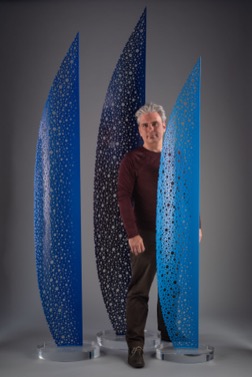
The Blue Eidolons
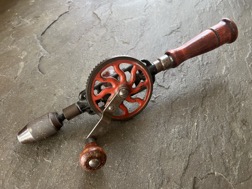
Millers Falls hand drill